Showing posts with label James Dean. Show all posts

Sunday, January 17, 2010

Plato is So Gay


"Wow. Those are some gay undertones," states my husband, Geoff, during the first planetarium scene in Rebel Without A Cause. Geoff is not a filmmaker, has never taken a film class, and generally avoids reading too much into media. However, even he is not convinced that Plato is, as he is described by others, just "the youthful innocent."

Quickly Googling for Plato+Gay+"Rebel Without A Cause" produces a myriad of results. Seems Geoff isn't the only one picking up on Plato's vibes. Roger Ebert had this to say about Plato's reaction to the planetarium presentation in Rebel Without A Cause:
"What does he know about man alone?" It is clear now but may have been less visible in 1955 that Plato is gay and has a crush on Jim; at the planetarium, he touches his shoulder caressingly. After Buzz dies when his car hurtles over the cliff, the students all seem curiously -- well, composed. Jim gives Plato a lift home and Plato asks him, "Hey, you want to come home with me? I mean, there's nobody home at my house, and heck, I'm not tired. Are you?" But Jim glances in the direction of Judy's house, and then so does Plato, ruefully.

No one brought up the question of Plato's sexuality at "An Afternoon with Stewart Stern" where I, and several lucky others, got to listen to stories of old Hollywood and talk with the screenwriter of Rebel Without A Cause - Stewart Stern. However, Stern did elude to Nicholas Ray having an interest in men. And that Stern was "so naive" about these things when he first started working in the film industry. Indeed, one blogger even went farther with the suggestive sexuality in the film stating:
Sal Mineo—so affecting as the essentially fatherless outcast Plato—later commented that he had portrayed the first gay teenager on film. There are little clues: the photograph of Alan Ladd taped to his locker door, his longing looks at Jim Stark, his disguised declaration of love in the abandoned mansion. Ray was aware of Dean’s bisexuality and encouraged the actor to use it in certain scenes. Dean instructed Mineo, “Look at me the way I look at Natalie,” for their intimate scene in the Getty mansion. It had to be subtle. A Production Code officer had written in a memo to Jack L. Warner on March 22, “It is of course vital that there be no inference of a questionable or homosexual relationship between Plato and Jim.” In real life Mineo was gay, and it is even rumored that he and Ray (who was bisexual) also had a tryst while filming Rebel.
While those of us who have seen the documentary or read the book The Celluloid Closet don't find any of this particularly shocking, the thing that still bothers me about homosexuality in mainstream film, latent or "out", is how much we like to punish the characters for their alleged transgressions. Here is a quick synopsis of mainstream Hollywood films that have come out in the last twenty years, been acclaimed by the masses and critics, featuring gay, bisexual, transgendered or otherwise "out" main characters and their celluloid fates:
  • The Crying Game. Dir: Neil Jordan. 1992. This one is hard to explain, but trust me when I say that this one does not end on a complete happy note. Dead and depressed.
  • Philadelphia. Dir: Jonathan Demme. 1993. Tom Hanks plays a gay attorney with AIDS who eventually succumbs to his disease. Dead.
  • Boys Don't Cry. Dir: Kimberly Pierce. 1999. Hillary Swank won an Oscar for playing a transgendered man who is shot and killed by his former friends once they learn his secret. Dead.
  • Far From Heaven. Dir: Todd Haynes. 2002. Dennis Qauid finally leaves his wife after revealing that he is gay only to be isolated, alone, and depressed in this contemporary re-make of Douglas Sirk's All That Heaven Allows. Depressed.
  • The Hours. Dir: Stephen Daldry. 2002. This film featured several contemporary "out" characters. One was stuck in a loveless relationship. The other threw himself to his death instead of allowing AIDS to take him. Dead and depressed.
  • Monster. Dir: Patty Jenkins. 2003. Charlize Theron won an Oscar for her portrayal of Aileen Wournos, a real-life lesbian/prostitute/serial killer, who is eventually tried and convicted for her crimes and sentence to death by lethal injection. Dead.
  • Brokeback Mountain. Dir: Ang Lee. 2005. Jake Gyllenhaal uttered the classic line "I can't quit you" to Heath Ledger in this story of two cowboys who fall in love with each other. However, eventually Jake Gyllenhaal is viciously murdered by men who learn his secret. Dead and depressed.
  • Transamerica. Dir: Duncan Tucker 2005. Felicity Huffman was robbed of the Oscar for her portrayal of a man transitioning to become a woman and the complications it brings with the discovery that she fathered a child. Alive and pretty much happy!
  • Milk. Dir: Gus Van Sant. 2008. Based on the real story of Harvey Milk who, like his fictional and real peers, is assassinated. Dead.
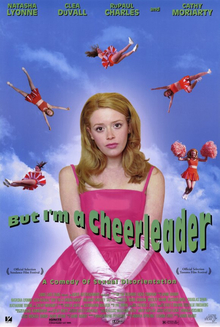
While there are cult favorites and independent films like But I am a Cheerleader (Dir: Jaime Babbit. 1999) and Kissing Jessica Stein (Dir: Charles Herman-Wurmfeld. 2001) that break taboos and allow for more positive gay, bisexual, and transgendered main characters it is almost unheard of in a mainstream or co-opted (small film that gets a lot of Oscar attention) Hollywood films. In fact, the only film that I could think of that has come out in the last twenty years, received mainstream critical and audience acceptance, and featured a character that did not die or end up completely emotionally devastated by the end of the film was Transamerica. This, to me, very clearly articulates an issue with how we feel culturally about LGBTQ men and women in our society - that they do not deserve happiness and acceptance like the heterosexual population. And while their presence has increased and "come out of the closet" since Rebel Without A Cause was released in 1955 they are still meeting the same fate as Plato time and time again - death. This is troubling. I challenge filmmakers large and small to think of better ways to deal with sexualities that break the heteronormativity mold than this disturbing trend of death, depression, and/or emotional destruction. In the meantime I will revel in the campy brilliance of But I am a Cheerleader.


Mad love to Lane, who, one night on a slow film set, helped to create the list of modern films and the fates of their main LGBTQ characters while simultaneously doing a handstand.

Rebel Without A Father


Stewart Stern is full of stories of old Hollywood. He is the nephew of Adolf Zukor, one of the pioneers of Paramount pictures, and cousins with the Loews family that used to control MGM. He told one story about sitting down on a couch at a party in Los Angeles and chatting up a bored Marilyn Monroe then told us about how after "Jimmy" Dean died he (and others close to him) felt haunted by his ghost. He described the Tiffany arboretum that was a part of the Loews mansion in Long Island that also served as inspiration for the mansion at the end of Rebel Without a Cause. He spoke of how his house guest, Beatrice Lillie, was so funny that he had to fake taking a trip to Palm Springs to escape her company because her jokes were so distracting to his work. Where did end up? The Chateau Marmot where he hung out with Dennis Hopper and eventually wrote the script for Rebel after meeting director Nicholas Ray. At 88 he is one of the few people left with such strong ties to old Hollywood. So when I raised my hand to ask my one question at the Northwest Film Forum presentation of "An Afternoon with Stewart Stern" screening I just really hoped that he didn't hit me with his cane, because it would have been like Marlon Brando (who he traveled through Asia with) and the rest of old Hollywood popping me one for making trouble and that would have been a little hard to handle for this film buff.

In America on Film: Representing Race, Class, Gender, and Sexuality at the Movies the authors use Rebel Without a Cause as an example of how film in the 1950s was full of images of masculinity in crisis: "The lingering effects of World War II and the new corporate economics of the 1950s were changing the social understanding of masculinity" (274). I had heard other readings of this film, but never that it was about a crisis in masculinity that was spurned by the effects of World War II. So, when spending an afternoon with the writer of the film I had to ask the question: "Do you believe that Rebel Without A Cause represents a 'crisis in masculinity' that was culturally present in 1950s America?"

After taking a long pause he replied, "Well, before World War II you always brought women corsages if you were taking them out on a date. After the war you didn't do that any more."

I have never heard someone describe shifting gender roles in such an eloquent way.

Stern stated said that the fathers in the film were influenced by the monotony that the 1950s man encountered as working life and gender roles shifted in the wake of World War II. He said, "They felt like drones. They went to work. They might play cards once a week. But that was it." One audience member put the blame on the masculine crisis on the Rosie-the-Riveter women who, after working the factories while the men were off fighting, continued to challenge gender roles after the end of the war. However, Stern was not so quick to judge stating that after World War II, "Fathers were loosing ground." He also admitted that there was little emotional support for the men returning from combat and that Post Traumatic Stress Disorder (PTSD) was a part of society, but not dealt with in a public forum. This undercurrent of emotion from wartime experiences were causing men to display feelings that, before the war, were traditionally "bottled up" and masculinity started to crack under the psychological pressure.


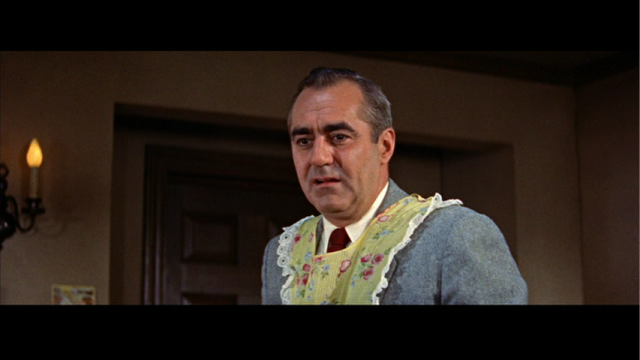
The display of masculinity in crisis embodied in Rebel in the character of Jim's father Frank Stark, played by Jim Backus. In one scene Frank drops a tray of food that he is taking his wife as Jim, James Dean's character, walks up the stairs. Frank is dressed in a gray suit with a flowery apron on which allegedly belongs to his wife. Jim is horrified to see his father on the floor and yells at him "Don't!" When Frank looks confused as to what Jim is referring to, Jim slinks off to his room upset at his father's emasculation at the hands of his overbearing mother. In fact, Stern hinted that the cold bottle of milk that Jim drinks throughout the film upon returning home is supposed to represent his mother - cold, ineffectual.

In fact, Jim's entire rebellion can be traced back to his feelings towards his "inadequate" father. Indeed, at the beginning of the film, Jim tells the juvenile detective that "She eats him alive and he just takes it." And later: "If he had guts to knock Mom cold once, then maybe she'd be happy, and she'd stop picking on him." Hinting that want he wants out of his father is the traditional role model of violent patriarchy and, in fact, that his mother might like that. In fact, the detective puts Jim into his place after he takes a swing, asserting his own place as an appropriate male role model through physical combat. Towards the end of the film, since Jim does not respect his father as a role model, he returns to the police station to try and find the detective to share his problems with. However, he is let down when he finds out that the detective is not there.

Stern said that to do background research to write the film, he spent several months shadowing a real juvenile detective. Much of the background for the main characters - Jim, Judy, and Plato - came out of this experience. In fact, Stern actually noted in his journal that one of the real-life inspirations was "In his mind searching for a father image..." But it was something that he could not find. True, neither Jim, Judy, or Plato could find the type of father figure that they wanted so they created their own family briefly in the abandoned mansion. So while the film is called Rebel Without A Cause, the truth is that the characters are actually rebelling against the oldest reason in the book - their fathers - and the fear of changing masculinity that they represent to 1950s America.