Showing posts with label Masculinity. Show all posts

Saturday, December 17, 2011

Progressive Masculinity in "Sherlock Holmes: A Game of Shadows"


I am always intrigued when a sequel is able to rise above the 60% mark on Rotten Tomatoes.  Thus, with Sherlock Holmes: A Game of Shadows hovering in the low 60th percentiles and, therefore, acquiring the status of "certified fresh" I figured I would give it a go.  I must say that I wasn't disappointed either.  But, as I tell my students, just because I liked the film doesn't mean that I can't critique it.  So let the fun and spoilers begin.

In this installment of the continuing sagas of Sherlock Holmes the detective is manic about a professor named Moriarty... or is it really something else that has got Holmes all in a huff?  At the beginning of the film Watson stops by Holmes' apartment to find the detective in a manic state.  True, Holmes is on the trail of Professor James Moriarty, but Watson is there to celebrate his stag night before he weds and cares little for Holmes' new venture.  With Watson's marriage looming Holmes' manic state seems to be worsening; as Holmes' housekeeper, Mrs. Hudson, points out he's been recently subsiding on coffee, tobacco, and cocoa leaves.  Now it is nothing new to say that the Guy Ritchie versions of the Sherlock Holmes saga are full of innuendo between Robert Downey, Jr.'s Holmes and Jude Law's Watson.  There are so many different critics and bloggers that have commented on this:

[Holmes]... more or less sabotages Watson's bachelor party, makes something of a comedy out of the marriage ceremony itself, then invades the couple's honeymoon train-compartment dressed as a woman. He tosses Mary off the train, and -- in torn dress and smeared lipstick -- falls bare-chested to the berth, commanding, 'Lie down with me, Watson.'  - John Beifuss

And I am not here to argue with them.  The bromance between Watson and Holmes is alive and well in the second installment of the series.  My interest in how the latent love between Watson and Holmes, coupled with the surprising attributes of the other male characters, makes for a stunningly progressive take on masculinity in an action film.  These men aren't your what-is-bigger-my-pecs-my-gun-or-my-ahem-masculinity sort of men.  These men are smart, they cry, they are crafty, they have strange phobias, they love women, and they love other men.  They have, in some ways, broken out of the box of stereotypical masculinity and they've done so in an action film.  This is no small feat.

First, let's look at Holmes nemesis, Professor James Moriarty, played by Jared Hess.  Moriarty is ruthless and uses his intellect to devise a plan to make money by selling weaponry after igniting a world war.  Moriarty is smart, cunning, and uninterested in women in the film.  In most action films he would be made to seem effeminate and exude homosexual vibes since real men, well, penetrate in all aspects of their life.  However, if you contrast Moriarty with Holmes, there isn't much of a difference between the two.  Holmes is smart, cunning, and more interested in Watson then women.  The one thing that divides Moriarty from Holmes is that he wants to profit off his wits and, to do so, he's ruthless and cunning.  The differences between the men is so slight that it opens up new possibilities for the cinematic other -- they can be evil because they choose to be evil, not because there are anything but white, heterosexual, and male like our protagonist  (see my other blogs on the cinematic other to see what I'm talking about).

Also, interesting in this film is Mycroft Holmes, Sherlock's brother, played by Stephen Fry.  Mycroft is your stereotypical latent homosexual character.  He is effeminate, clean, and has a man servant with him at all times.  He is a committed bachelor who wonders around his house naked while telling the newly-minted and decidedly perturbed Mrs. Watson that he "might grow to enjoy the company of a person of your gender."  In your typical action film Mycroft Holmes would be the antagonist, he's everything a real-man is not.  But he's not the antagonist of this film.  In fact, he has a lot of power working in a unspecified job in the higher levels of the English government.  It is extremely unusual to see a character like Mycroft be so integral to the success of the main character in an action film and, also, live to see the end credits roll.

Allowing men to show compassion for another man (Watson and Holmes hold hands) and a series of personality quirks (Holmes hates horses and Mycroft doesn't like to touch other people) are newer contributions to the acceptable characteristic given to male characters in the action genre.  This expansion of the masculine box is the type of progress I am happy to report.  Now if only there were good things to say about the female characters in the film...  Oh well, one step forward, one step back.

Saturday, April 24, 2010

Things I Love: Seth Aaron Henderson


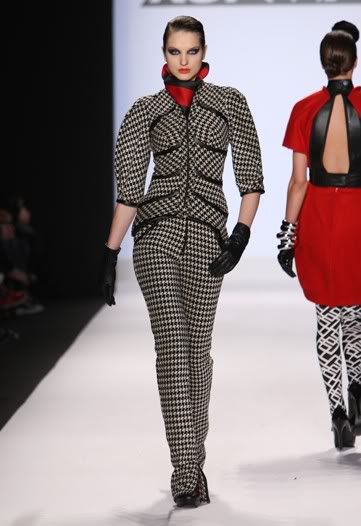
I am lucky lady. My job revolves around being creative. I make movies. However, regardless of how lucky I feel to be a filmmaker, sometimes I need to do something else. Thus, I sew. I am not a good seamstress by any means; the tool that I use most is probably my seam ripper. Therefore I am easily fascinated by those who have more skill than I. Thus, I love Project Runway. In season seven this love was focused on one designer in particular - Seth Aaron Henderson.


The funny thing is that it had little to do with his work. Truthfully, I would never wear most of clothes. They just aren't me. Grunge rock star I am not.

The reason why I love Seath Aaron Henderson is that he is a straight, married man with teenage kids who still wants to be a fashion designer.

In Tough Guise Jackson Katz talks about how masculinity (and femininity to a point) are all about fitting into these really rigid boxes that do nothing but to keep us confined and from fully actualizing as human beings.

Truth be told I don't know many men who can sew even though sewing is an important life skill. I don't mean that you have to be able to churn out couture, but everyone puts premature holes in clothes from time to time and it is a great skill to be able to fix those. Thus, I applaud Seth Aaron Henderson for not only rocking the runway with his punk/military/goth look, but being a straight man who is living outside the gender conforming box.

However, there is a flip side to this sew-tastic story. We live in a culture that is male dominated, male identified, and male centered. Does having a straight man win at a reality contest in a traditionally female-centered discipline really help to break down our rigid gender constructions? Or is is just another example of how white (straight) men are the best at everything... including sewing? It is an interesting dichotomy. Is this really progress? Or is it just another male takeover? I, personally, can't decide. So I put this quagmire out to the masses. I am going to go back to ripping out seams.

Pictures from:
Also mentioned:

Tuesday, April 6, 2010

Men: If You Change Your Name, Your Wife Will Cheat

When I got married I told my husband I loved him, but I wasn't really into changing my name. Why? There are lots of reasons - Ruth Gregory is the name that I have always been called; Ruth Gregory is my grandmother's (married) name and she is who I am named after; Ruth Gregory is what I am professionally known as; Ruth Gregory is who I am. And while changing my last name doesn't mean that I cease to exist and have to start over personally and professionally, it felt like that, and that was enough for me to stick with my maiden name despite all the flack I have gotten and continue to get for it.

Last weekend I finally gave in and went to see Hot Tub Time Machine. I gave in because multiple people had told me that the film had a soul beneath the silliness and that it was worth the price of admission. And so I went. And it was fun. But there was one thing that irked me deeply about the film and it wasn't even central to the story. Thus, I feel the need to blog about it. This will have spoilers.

In Hot Tub Time Machine one of the friends Nick Webber, played by Craig Robinson of "The Office", is a happily married, but totally emasculated, man. He has, essentially, given up everything to be with the woman that he loves; his music career and his friends (to an extent). He has also at the beginning of the film, duh, dun, duh! hyphenated his last name. And boy, do his "friends" give him crap for that.

On top of it all, he's found out that the love of his life, his wife, Courtney, has cheated on him. So all his sacrifice seems to be for nothing.

Through the magic of hot tub time travel Nick is able to change his present by altering the past. In this new present, he is a man in charge of his life. He has his friends back, he is a successful music producer, he is still married to the woman he loves, Courtney, and his name is no longer hyphenated. He is just Nick Webber.

Now, I don't judge women or men who hyphenate or change their names for whatever reason, but Hot Tub Time Machine sure as heck does. See in the new and improved future Nick's wife has not cheated on him. She is still madly in love with him and his re-asserted masculinity. Also, the guy she cheated on him with in the alternate reality is now his secretary. Take that!

Thus, the writers and director of Hot Tub Time Machine are judging the Courtney's of the world (and I feel, me, by extension) by putting out the message to the men of the world that if you love a strong woman who wants you to change your name, that this will lead to totally emasculation that she will eventually tire of, and, thus, she will eventually sleep with a "Tyrese-looking fella" who, I can only assume, dominated her in the way that men are supposed to dominate women.

So men, be aware. If you change your name, your wife will cheat.

Friday, April 2, 2010

Seriously? A "Red Dawn" Remake?


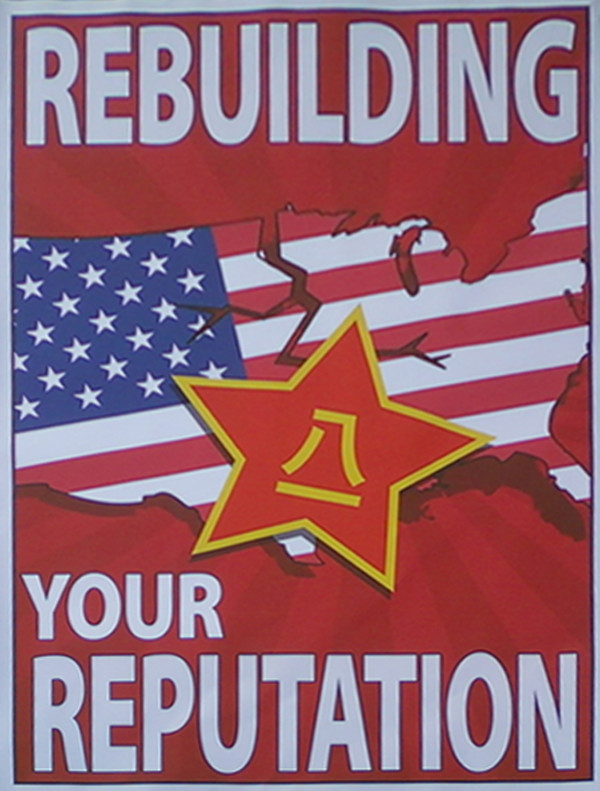
In the years I call "Grad School Part 1" I wrote a paper about how the teen films of the 1980s were full of anti-communist propaganda. My point was based off Susan Jefford's book Hard Bodies: Hollywood Masculinity in the Reagan Era. In her piece Jeffords talks about how masculinity in Hollywood films of the 1980s was unusually macho - think Rambo, Rocky, Arnold Schwarzenegger's work, the Die Hard franchise, Top Gun, etc. - and that these films were a direct response to the political climate of the time. In the 1980s there was a cultural backlash going on against what was seen as the "soft" 1970s; where president Jimmy Carter was seen praying with the families of hostage victims in Iran instead of kicking some ass. Ronald Reagan himself was seen as somewhat of a cowboy figure, riding in on his horse to save the day. Sounds familiar...


In the midst of all this macho manliness came the ultimate Boy Scout wet dream of a film Red Dawn (1984). In it every communist nation (beside China) invades the U.S. and it is up to a bunch of high schoolers who have magically escaped to the mountains in the nick of time to save us. They fight using the skills they have inherited from fishing and camping with their fathers against the evil commie invaders. The Wolverines, as they call themselves, pissed off at the invasion of their country launch guerrilla warfare on their invaders; including creating improvised explosive devices (I.E.D.s) and going on suicide bombing missions when it looks like there is no hope. Sound familiar....

While there are some interesting real-world parallels going on here, the end result was one heck of a cheesy teen flick.

So why we feel to re-make Red Dawn is beyond me. And why Hollywood has decided that China is now the only invading country is way, way beyond me. In the first Red Dawn China is the only country that doesn't participate in the massive US takeover. It is because in the real 1980s we had good trade relations with China. Interestingly, we still have good trade relations with China. So what would motivate them to invade us now? Even in a fictional sense? Well, as my colleague Kris stated, "Maybe they want all their money back." It is possible. We do owe them more than 770 billion dollars. So, in some ways, I hope that the new Red Dawn addresses this issue. Otherwise, it will just be another 1980s remake that should have never been rehashed.

Although I am not a fan of Rob Schneider, I would much rather see the film based on this fake film preview from Funnyordie.com!

Sunday, January 17, 2010

Rebel Without A Father


Stewart Stern is full of stories of old Hollywood. He is the nephew of Adolf Zukor, one of the pioneers of Paramount pictures, and cousins with the Loews family that used to control MGM. He told one story about sitting down on a couch at a party in Los Angeles and chatting up a bored Marilyn Monroe then told us about how after "Jimmy" Dean died he (and others close to him) felt haunted by his ghost. He described the Tiffany arboretum that was a part of the Loews mansion in Long Island that also served as inspiration for the mansion at the end of Rebel Without a Cause. He spoke of how his house guest, Beatrice Lillie, was so funny that he had to fake taking a trip to Palm Springs to escape her company because her jokes were so distracting to his work. Where did end up? The Chateau Marmot where he hung out with Dennis Hopper and eventually wrote the script for Rebel after meeting director Nicholas Ray. At 88 he is one of the few people left with such strong ties to old Hollywood. So when I raised my hand to ask my one question at the Northwest Film Forum presentation of "An Afternoon with Stewart Stern" screening I just really hoped that he didn't hit me with his cane, because it would have been like Marlon Brando (who he traveled through Asia with) and the rest of old Hollywood popping me one for making trouble and that would have been a little hard to handle for this film buff.

In America on Film: Representing Race, Class, Gender, and Sexuality at the Movies the authors use Rebel Without a Cause as an example of how film in the 1950s was full of images of masculinity in crisis: "The lingering effects of World War II and the new corporate economics of the 1950s were changing the social understanding of masculinity" (274). I had heard other readings of this film, but never that it was about a crisis in masculinity that was spurned by the effects of World War II. So, when spending an afternoon with the writer of the film I had to ask the question: "Do you believe that Rebel Without A Cause represents a 'crisis in masculinity' that was culturally present in 1950s America?"

After taking a long pause he replied, "Well, before World War II you always brought women corsages if you were taking them out on a date. After the war you didn't do that any more."

I have never heard someone describe shifting gender roles in such an eloquent way.

Stern stated said that the fathers in the film were influenced by the monotony that the 1950s man encountered as working life and gender roles shifted in the wake of World War II. He said, "They felt like drones. They went to work. They might play cards once a week. But that was it." One audience member put the blame on the masculine crisis on the Rosie-the-Riveter women who, after working the factories while the men were off fighting, continued to challenge gender roles after the end of the war. However, Stern was not so quick to judge stating that after World War II, "Fathers were loosing ground." He also admitted that there was little emotional support for the men returning from combat and that Post Traumatic Stress Disorder (PTSD) was a part of society, but not dealt with in a public forum. This undercurrent of emotion from wartime experiences were causing men to display feelings that, before the war, were traditionally "bottled up" and masculinity started to crack under the psychological pressure.


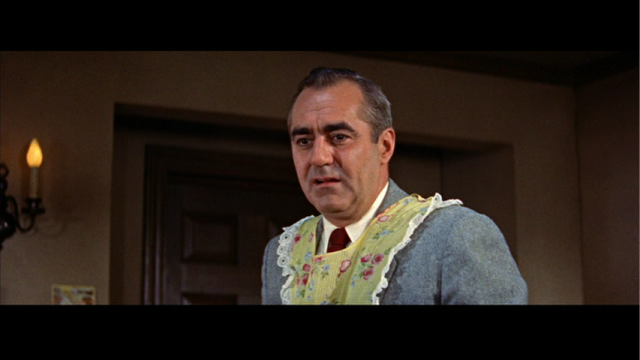
The display of masculinity in crisis embodied in Rebel in the character of Jim's father Frank Stark, played by Jim Backus. In one scene Frank drops a tray of food that he is taking his wife as Jim, James Dean's character, walks up the stairs. Frank is dressed in a gray suit with a flowery apron on which allegedly belongs to his wife. Jim is horrified to see his father on the floor and yells at him "Don't!" When Frank looks confused as to what Jim is referring to, Jim slinks off to his room upset at his father's emasculation at the hands of his overbearing mother. In fact, Stern hinted that the cold bottle of milk that Jim drinks throughout the film upon returning home is supposed to represent his mother - cold, ineffectual.

In fact, Jim's entire rebellion can be traced back to his feelings towards his "inadequate" father. Indeed, at the beginning of the film, Jim tells the juvenile detective that "She eats him alive and he just takes it." And later: "If he had guts to knock Mom cold once, then maybe she'd be happy, and she'd stop picking on him." Hinting that want he wants out of his father is the traditional role model of violent patriarchy and, in fact, that his mother might like that. In fact, the detective puts Jim into his place after he takes a swing, asserting his own place as an appropriate male role model through physical combat. Towards the end of the film, since Jim does not respect his father as a role model, he returns to the police station to try and find the detective to share his problems with. However, he is let down when he finds out that the detective is not there.

Stern said that to do background research to write the film, he spent several months shadowing a real juvenile detective. Much of the background for the main characters - Jim, Judy, and Plato - came out of this experience. In fact, Stern actually noted in his journal that one of the real-life inspirations was "In his mind searching for a father image..." But it was something that he could not find. True, neither Jim, Judy, or Plato could find the type of father figure that they wanted so they created their own family briefly in the abandoned mansion. So while the film is called Rebel Without A Cause, the truth is that the characters are actually rebelling against the oldest reason in the book - their fathers - and the fear of changing masculinity that they represent to 1950s America.