Showing posts with label female characters. Show all posts

Friday, February 20, 2015

Music of the Spheres: An experiment in interactive storytelling


A pious woman who cuts out people's tongues; a mysterious man who has aligned with the enemy to save his wife; a frustrated professor who is looking to capture real power at any cost; a desperate father with a death wish who is stuck in a time loop; and a replica who is as loving as she is brutally cruel.  They are all standing in the way of Angela as she searches for the 9 blades that make up the mystical ancient weapon developed by Pythagoras called the Music of the Spheres; a weapon, that when fully assembled, can completely alter space and time.

All that and the viewer has control over the story.

Award-winning filmmaker Ruth Gregory has launched a Kickstarter campaign for “Music of the Spheres” an interactive, female-centered, sci-fi web series to be shot this summer in Washington state.

“I decided that after producing ‘Maikaru’ [which one best documentary short at the Seattle International Film Festival making it Oscar-eligible] that it was time for a new challenge,” Gregory said, “I’m a huge sci-fi fan and have always wanted to take the plunge in that direction as a filmmaker.  This just seemed like the right time.”

But an interactive web series?  How does that work?

“The net is a great communication tool so why not invite your audience into the creative process instead of just presenting your show like we’ve done for years on network television,” Gregory states. “I was thinking about it in a very formalist manner – as mediamakers no one has really tried to maximize what you could do with media on the a platform like the internet and I wanted to explore the possibilities.”

The “Music of the Spheres” episodes will be freely available on the web, but the pay community that surrounds the show – the Order of the Spheres – will financially and creatively support the show as it moves forward.  “We wanted to give our pay fans the opportunity to be a part of the show in a unique way.  And you can’t get much more intimate that becoming a part of the creative process!”

The cast includes a bevy of Washington talent including actors who’ve been on television shows like Syfy’s “Z Nation” and NBC’s “Grimm” as well as high-profile movies like Wild and Safety Not Guaranteed.  Rosalie Miller is attached to play the main character, Angela.  The primary cast also includes Wonder Russell (Betty), Tony Doupe (Dan), Lowell Deo (Scott), Jennifer True (Petra), and Jodie Harwood (Pam).


The “Music of the Spheres” Kickstarter campaign is live until 10pm on March 1at www.WheresAngela.com/Kickstarter.

Saturday, December 17, 2011

Progressive Masculinity in "Sherlock Holmes: A Game of Shadows"


I am always intrigued when a sequel is able to rise above the 60% mark on Rotten Tomatoes.  Thus, with Sherlock Holmes: A Game of Shadows hovering in the low 60th percentiles and, therefore, acquiring the status of "certified fresh" I figured I would give it a go.  I must say that I wasn't disappointed either.  But, as I tell my students, just because I liked the film doesn't mean that I can't critique it.  So let the fun and spoilers begin.

In this installment of the continuing sagas of Sherlock Holmes the detective is manic about a professor named Moriarty... or is it really something else that has got Holmes all in a huff?  At the beginning of the film Watson stops by Holmes' apartment to find the detective in a manic state.  True, Holmes is on the trail of Professor James Moriarty, but Watson is there to celebrate his stag night before he weds and cares little for Holmes' new venture.  With Watson's marriage looming Holmes' manic state seems to be worsening; as Holmes' housekeeper, Mrs. Hudson, points out he's been recently subsiding on coffee, tobacco, and cocoa leaves.  Now it is nothing new to say that the Guy Ritchie versions of the Sherlock Holmes saga are full of innuendo between Robert Downey, Jr.'s Holmes and Jude Law's Watson.  There are so many different critics and bloggers that have commented on this:

[Holmes]... more or less sabotages Watson's bachelor party, makes something of a comedy out of the marriage ceremony itself, then invades the couple's honeymoon train-compartment dressed as a woman. He tosses Mary off the train, and -- in torn dress and smeared lipstick -- falls bare-chested to the berth, commanding, 'Lie down with me, Watson.'  - John Beifuss

And I am not here to argue with them.  The bromance between Watson and Holmes is alive and well in the second installment of the series.  My interest in how the latent love between Watson and Holmes, coupled with the surprising attributes of the other male characters, makes for a stunningly progressive take on masculinity in an action film.  These men aren't your what-is-bigger-my-pecs-my-gun-or-my-ahem-masculinity sort of men.  These men are smart, they cry, they are crafty, they have strange phobias, they love women, and they love other men.  They have, in some ways, broken out of the box of stereotypical masculinity and they've done so in an action film.  This is no small feat.

First, let's look at Holmes nemesis, Professor James Moriarty, played by Jared Hess.  Moriarty is ruthless and uses his intellect to devise a plan to make money by selling weaponry after igniting a world war.  Moriarty is smart, cunning, and uninterested in women in the film.  In most action films he would be made to seem effeminate and exude homosexual vibes since real men, well, penetrate in all aspects of their life.  However, if you contrast Moriarty with Holmes, there isn't much of a difference between the two.  Holmes is smart, cunning, and more interested in Watson then women.  The one thing that divides Moriarty from Holmes is that he wants to profit off his wits and, to do so, he's ruthless and cunning.  The differences between the men is so slight that it opens up new possibilities for the cinematic other -- they can be evil because they choose to be evil, not because there are anything but white, heterosexual, and male like our protagonist  (see my other blogs on the cinematic other to see what I'm talking about).

Also, interesting in this film is Mycroft Holmes, Sherlock's brother, played by Stephen Fry.  Mycroft is your stereotypical latent homosexual character.  He is effeminate, clean, and has a man servant with him at all times.  He is a committed bachelor who wonders around his house naked while telling the newly-minted and decidedly perturbed Mrs. Watson that he "might grow to enjoy the company of a person of your gender."  In your typical action film Mycroft Holmes would be the antagonist, he's everything a real-man is not.  But he's not the antagonist of this film.  In fact, he has a lot of power working in a unspecified job in the higher levels of the English government.  It is extremely unusual to see a character like Mycroft be so integral to the success of the main character in an action film and, also, live to see the end credits roll.

Allowing men to show compassion for another man (Watson and Holmes hold hands) and a series of personality quirks (Holmes hates horses and Mycroft doesn't like to touch other people) are newer contributions to the acceptable characteristic given to male characters in the action genre.  This expansion of the masculine box is the type of progress I am happy to report.  Now if only there were good things to say about the female characters in the film...  Oh well, one step forward, one step back.

Sunday, January 2, 2011

Tiny Furniture

 
Tiny Furniture is an independently made film directed by and starring Lena Durham about a young woman named Aura who is dealing with life after college while staying in her Mom's Tribeca loft. She's just been dumped by her long-term boyfriend and graduated from a unnamed college in Ohio with a degree in film theory.

The film has made a deep impression on me and not just because Aura's journey is much like my own (substituting the hip Tribeca loft with the not-so-hip rural Washington digs). The way that the film really stood out to me was that it didn't pass the reverse of The Bechdel Test; it had two men in it with names, but they never spoke to each other. Almost all of the primary case of characters in the film are women. I was completely struck by the lack of male presence in the film and the large amount of fully fleshed out female characters.  After getting over my initial shock I was saddened to think that I was surprised at the amount of women in one film at all.  Is it really so rare that there are large casts of women in a film?  I would sadly say "yes."  So I started thinking about how many films I could name that I've seen in the past couple of years that had more than two women in the main character cast:
  • Bridesmaids
  • The Help
  • Thor
  • Tiny Furniture
  • Burlesque
  • Black Swan
And that's it.  Can anyone else think of films with more than two women in the main character cast that have come out recently?  This list is pathetically short.


More info about Tiny Furniture is here.

Tuesday, March 16, 2010

Fat Actresses

Re: Just Wondering: Can we please give the Gabourey Sidibe body scrutiny a rest?


During the 2010 Oscars I was preoccupied with the possibility that Kathryn Bigelow would be the first woman to win Best Director. However, a close second on my radar was Gabourey Sidibe. I love her persona and unabashed self-confidence. When asked by E! how she felt in her dress she said: "Hot!" And not in a please get me a fan sort of way; no she thought she looked good. In a sea of Hollywood starlets who are trying to stay in the 0 - 2 size range, she still felt smokin'. Gabourey rules.

Now the article linked to above discusses how the scrutiny of Gabourey's size is the sole reason why she won't be a success in Hollywood according to the media. And how the media needs to tone it down. True. Howard Stern needs to stuff a sock in it, but the article is horribly short-sighted on the issue of women and weight in Hollywood.

In the early '00s I did my stint as a page at a major Hollywood studio. My outfit made me look a lot like Kenneth from 30 Rock and was 99% polyester; lots of fun to wear in the Southern California sun. One of the best parts of being the lowliest of the low on a studio lot is that you can go almost anywhere and no one will care that you are there. Hence, how I was able to survive working minimum wage in Los Angeles, by helping myself to every craft service table I was near. When I wasn't liberating Luna bars I was checking out the celebrities who were working on the lot. The one thing that startled me about actors and actresses in person is that their heads looked abnormally large in comparison to their bodies. We called them lollipops and they were everywhere. Aside from having abnormally large heads, it wasn't hard to see that the ladies of the silver screen are way too skinny. I also saw more protruding collar bones in my 8 months in Los Angeles than I've seen in the time since.

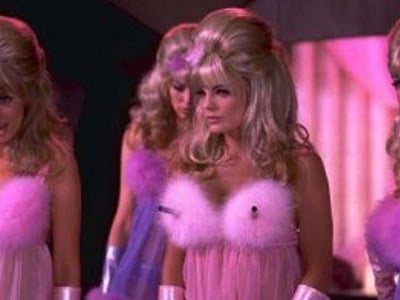
In recent years we've been trying to tell ourselves that a new type of woman is becoming more successful in mainstream media; a bigger woman, a real-looking woman. However, I don't believe that it is true. I am not saying this because I love to look at the scary skinny Hollywood actresses or models who subside on water and cigarettes, but because we are fooling ourselves into believing that there has been a massive cultural shift away from the super-skinny actress. For instance, Gabourey's story is so similar to another actress who burst onto the scene a couple of years ago - Nikki Blonsky - but then faded into oblivion.


"I'm not saying it's correct, but it's a simple fact that [Gabourey] will have to lose a lot of weight if she wants to keep getting parts," a casting director told Popeater. "The same thing happened to Nikki Blonsky from 'Hairspray.' Everyone said how great she was, and she hasn't worked since."


Ouch.

While some critics of the critics have said that Gabourey has already gotten her revenge by landing a reoccurring part on an upcoming Showtime series, I have to disagree that this indicates any sort of equity or larger cultural shift. For a comparison, let's look at the Best Actress nominees from last couple of years and see what they are up to:

2007
Marion Cotillard – co-starred in Nine with Oscar-nominated Best Supporting Actress Penelope Cruz. Has several forthcoming pictures including a new Woody Allen project.
Cate Blanchett – multiple high-profile film projects coming up including Robin Hood and the Hobbit.
Julie Christie – Hollywood legend who just starred in New York, I Love You. However, has no projects in development (according to IMDB).
Laura Linney – Has a couple of films in production. Also starred post-Oscar nomination as Abigail Adams in the acclaimed mini-series John Adams.
Ellen Page – couldn't be busier. Has several film projects in the works. Also starred in one of my favorite 2009 films - Whip It.

2008
Kate Winslet – has several projects in the works including a t.v. version of the film noir classic Mildred Pierce.
Anne Hathaway
– has 7! films in development and two in post-production.
Angelina Jolie – multiple film projects on their way including Salt. A film where she replaced Tom Cruise(!) as the lead character.
Melissa Leo – has worked on several high-profile independent films since her nomination. Will also be working on Mildred Pierce with Kate Winslet.
Meryl Streep – has received the most Academy Award nominations of any person ever when she was nominated once again in 2010 for the 16th time!

While cable T.V. has been churning out some interesting shows in the past decade and half, it still doesn't have the luster that high-profile film gigs do. To prove point about how we have a long way to go to reach size equity in media let's look at the forthcoming projects of Carey Mulligan, who is newer to the Hollywood scene and was also nominated for a Best Actress Oscar in 2010 for her role in An Education. Forthcoming she is co-starring in Wall Street 2 which is directed by Oliver Stone. Also in the works is a re-make of My Fair Lady where she gets to play the role of Eliza Dolittle. Aside from those two projects she has two others in development.

If culturally we'd really reach a point of equity in Hollywood then Gabourey Sidibe and Nikki Blonsky would be co-starring in a film where their weight is not an issue and they still get to live happily ever after or, at least, go on a crazy adventure where men are not the focus of their mission. I hate to be the pessimist, but we have a long way to go before we reach that level of equity. For some intangible reason there is a belief that no one would watch this movie. However, I would like to say that I would put my $10 down to watch a film like this opening night. I look forward to finally seeing something a little different on opening night than the same ol' lollipop kid.

Wednesday, February 10, 2010

Sex, Abelism, and the 80s: "Children of a Lesser God"


The 1980s were awesome in America. Or, at least, that is how I remember them. Granted, my vision of life and media was pretty narrow at the time. I was focused on how I could be more like She-Ra and Wonder Women and why the Skeksis in Jim Henson's film The Dark Crystal (1982) were so scary. Yep. I am a child of the 80s.

Recently I decided to watch Children of a Lesser God (1986). It was too adult for me when it came out in the mid-1980s and, realistically, I wouldn't have enjoyed it any way since I would have been totally grossed out by all the sex. Like. Totally. As an adult who doesn't believe in cooties any longer (most days) must admit that I found the film really interesting in terms of how it attempted to transform the image of the disabled from their usual villainous position as the cinematic other to something that is much more empathetic. Emmanuel Levy commented about Children of a Lesser God:

Not only Matlin benefited exposure-wise from the film: it did a lot of good for deaf actors and actresses in general. The hope of deaf actors and actresses at that time was that they could start getting parts in films that were not necessarily about being deaf people. The triumph of Marlee Matlin at that time, as well as others like Phyllis Frelich (who won a Tony award in the original play of Children of a Lesser God) and Howie Seagro were boosts for the National Theater for the Deaf, which had been fighting many years for such a breakthrough. Children of a Lesser God marked a breakthrough time for deaf actors.


However, that does not mean that the film was still not problematic.

Roger Ebert had an interesting comment about the way in which Children of a Lesser God was constructed to get around the fact that one of the characters, the deaf woman Sarah (played by Marlee Matlin), does not speak for most of the film:

The movie uses a strategy that works well - if you accept the basic premise, which is that everything said on the screen must be heard on the soundtrack. Marlee Matlin, who plays the deaf woman, signs all of her dialogue, and William Hurt, who plays the teacher, then repeats it aloud, as if to himself. "I like to hear the sound of my own voice," he says at one point, and indeed he does such a smooth and natural job of translation that the strategy works.

But think for a minute: Hurt can hear and can read sign language; Marlin's cannot hear or (she claims) read lips, and can only communicate by signing. In many movies about two major characters, there are scenes from two points of view. In "Children of a Lesser God," the scenes between the two of them are from Hurt's point of view, and none of them are played without sound.

I'm not suggesting silent scenes where we have to guess what the sign language means. But how about a few silent scenes in which the signs are translated by subtitles, giving us something of the same experience that deaf people have (they see the signs, and then the subtitles, so to speak, are supplied by their intelligence).

The feeling of seeing Hurt and not hearing him, of looking out at him from a silent world, would have underlined the true subject of this movie, which is communication between two people who speak differently.

By telling the whole story from Hurt's point of view, the movie makes the woman into the stubborn object, the challenge, the problem, which is the very process it wants to object to.


Regardless of how the film is remember - as a "breakthrough" for deaf actors or just another example of how women are perceived as stubborn - it is interesting to note that deaf characters in main roles have all but disappeared from popular cinema. Mr. Holland's Opus (1995) and The Family Stone (2005) featured secondary characters who were deaf, but aside from that there has not been much in the way of Hollywood films that feature deaf main characters. Even Marlee Matlin, who is deaf, has been relegated to mostly TV guest spots after her Oscar-winning turn as Sara in Children of a Lesser God. It as if the inclusion of hearing-impaired character has fallen on the deaf ears of Hollywood producers.

* Ebert, Roger. "Children of a Lesser God"

* Levy, Emanuel. "Children of a Lesser God"

Tuesday, January 26, 2010

The Cinematic Other: Dominatrix

For the past couple of days my husband and I have been watching the mini-series Tin Man which originally aired on Syfy. It is a retelling of the classic Wizard of Oz. Many of the players are the same, Dorothy, Toto, the Tin Man, Scarecrow, the Cowardly Lion, and wizard. However, each has been retooled to appeal to a modern audience; including the wicked witch, now known simply as "sorceress".

In the original film version of the Wizard of Oz the Wicked Witch of the West looked like this:
She represented many of the things that I feared as a child - old people, ugly women, long fingernails, warts, disfigurement, and aliens (who are also green). And that is exactly what the cinematic other is supposed to be. The cinematic other is a concept by which we inscribe our cultural fears onto the evil or othered characters in film. These attributes shift with time, but are always from a white, heterosexual, middle-class/upper-class, male position since they are the ones who control American (and global) media. Thus, women, children, homosexuals, foriegners, old people, immigrants, people of color, etc. etc. are generally cast as the "other" or villain in Hollywood films.

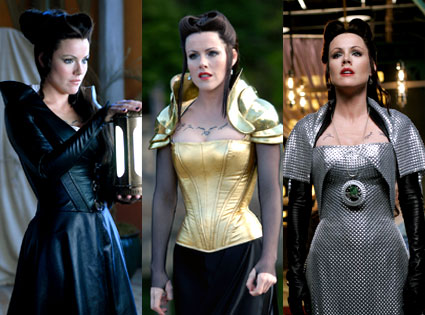
Now the sorceress in Tin Man looks a little different from her predecessor:Yep. She's been dominatrixed up for the 21st century. Indeed, even E's Kristen Dos Santos picked up on it in her write-up "Tin Man: Welcome to the O.Z., Bitch!" (C'mon Kristen, do you have to use the B-word?):
Kathleen Robertson's Azkadellia manages to be exquisitely beautiful without sacrificing any of the terrifying that Margaret Hamilton pulled off so well. Think Darth Vader in an S&M corset. Seriously—keep an eye on her cleavage, because this miniseries has some majorly good boob acting.
And it is true Kathleen Robertson's boobs do get to act in this incantation of the Wizard of Oz. Seriously, I wish I was joking.

Aside from Tin Man, the dominatrix as the evil character has been popping up all over the place the last couple of years.

Sienna Miller got to don the vinyl and heels in G.I. Joe to play the villainous Baroness.


Cate Blanchett's character in Indiana Jones and the Crystal Skull is a Russian dominatrix (she is caring a crop whip on her hip, but never rides a horse in the film). Her stereotypical depiction of Russian womanhood actually offended the communist party so much they tried to have the film banned in Russia.Then there is the Disney version of the dominatrix from Enchanted. Now while I can watch Tin Man as an adult and roll my eyes every time I see Kathleen Robertston strapped into another corset, Enchanted was made by Disney for a youthful audience who probably have not studied how film reflects, but more importantly, influences our culture. Thus, they begin to absorb the message that sexual deviance (meaning anything but missionary, monogamous sex with your husband or wife) is evil. Undoubtedly, children's films are usually the most evil when it comes to how they code their villains with all the attributes that are culturally unacceptable to the conservative white men who dominate film production. I will go into this in more in another post since there is so much more to be discussed, but in the meantime think about all the Disney villains you've ever seen and who they culturally represent. Crazy, isn't it.

It is easy to see that with the return of the dominatrix as the cinematic other in recent Hollywood films and television shows that patriarchal fear of kinky sex and powerful women has not diminished one bit (I must confess that I actually have a lot of respect for anyone who can don high heels, wear an outfit completely made out of vinyl and do anything but sweat). Male fear is also now heightened in Tin Man to show how mystical, magical, and confusing boobs are to the male population. So I conclude this post with this ominous message - don't make us mad otherwise we ladies will unleash the full power of our cleavage on society and it won't be pretty. Just think Fembots from Austin Powers.

Saturday, January 23, 2010

Things I Love: "Female Agents"


I love Les Femmes de L'Ombre (Female Agents). I saw it at the Seattle International Film Festival several years ago and cried my way through the opening sequence; war films tend to get the better of me as I think about the real life death and destruction that they are based upon. However, this particular sequence made me tear up for completely different reasons - it was a series of still images from World War II showing women in uniform serving their countries. Yep, I cry when I see images of women in power. It is so unusual on celluloid that it brings out a lot of emotion in me. Strange, I know. But we all have the things that make us descend into waterworks without control.

In Female Agents Sophie Marceau plays Louise Defontaines. The character of Louise is based on the real life of Lisé Marie Jeanette de Baissac Villaneur, a French female agent in the French resistance during World War II. While the screenplay has been sauced up for dramatic effect, Lisé had a dramatic effect on the success of the resistance and Allies before the D-Day invasion. In the film she is the reason for Allied success at Normandy beach as she races with other female spies to keep information about the D-Day invasion a secret from the Germans. In the film she and her crew get to shoot machine guns (cool), blow up buildings (cooler), work in a team of women without getting catty (seriously, it is possible), and generally make the German commander on their tail miserable. At the same time, the women show compassion for one another and fear in the face of danger ultimately making the film a fabulous mix of action and true emotion. The film also stars Julie Depardieu, the daughter of Gérard Depardieu, so it passes the requirement that all French films are held to - that they contain at least one Depardieu.

Now, unlike Avatar, where women ultimately bow to the power that the white male main character has over them, the women in Female Agents do no such thing. When things get rough they band together. When things get even rougher they think of a new plan. There are men in the story, including Louise's brother Claude, but the women and men stand on equal ground and, ultimately, it is up to the women and just the women to save the day.

While I worry that even with my vagueness has given too many spoilers away, I know that not many of you in the U.S. will ever even see this movie. I am not trying to say there is some sort of conspiracy, but there is - Female Agents is only available on PAL (European format) DVDs. However, those of you with the ability to play PAL in the Seattle area (aka you have a computer with a DVD-ROM) can pick it up at Scarecrow video and watch it in all its glory. Its unavailability everywhere else does make me wonder why? why?! WHY! Why is it not available in the U.S.? Do distributors think we do not want war films based on real life events and people? There are so many of those - Saving Private Ryan, Schindler's List, Band of Brothers, The Great Escape, Pearl Harbor, The English Patient, Patton, etc. etc. Do distributors think that we do not want films that re-invision World War II? Can't be that - the masses turned out for Inglorious Basterds this past summer. Hey, but I see a trend in these films! They are all about men and their forays into the field during war. The women, at best, get to be strangled by psychopathic German officers who are based on real people, but most of the time they are just nurses. While nurses do play a vital part in wartime situations isn't it about time that we show images of women in combat gettin' it done. And not like Courage Under Fire where Meg Ryan fights and, just like so many films with women with any sort of agency in them, dies. I mean really gettin' it done. Like being in the mix and living to tell the tale, exerting their full emotional and physical power, and doin' it like we know we can. Seriously. Someone make this film.

Monday, January 11, 2010

"Avatar" and How White Men Are the Best at Everything


The director of Avatar, James Cameron, has made a living out of making films with paper-thin narratives, cliched characters, but with lots of pretty things to look at. Avatar is no different. I must admit that I enjoyed the thrill-ride while I was on it, but looking back on the film now just makes me ever so sad.

The story goes that the Na'vi, the indigenous population (read: Native Americans) in the way of the progress of a greedy corporation (read: white Europeans), live on a remote world called Pandora (read: pre-colonial America). To try and convince them that they should move so that we can take over their land and cultivate the precious metal that lies beneath their sacred tree-home, we send Avatar Na'vi to integrate with the locals. The "dreamwalkers," as the Na'vi call them, are humans who, through the power of technology, can put themselves into the bodies of laboratory-grown half-Na'vi half-human beings. And thus, the futuristic reenactment of Manifest Destiny begins. However, this time the Avatars side with the Na'vi as the greedy corporation tries to plow down their sacred tree in order to mine the precious metal below and win in the face of interstellar corporate greed.

Now, there have been a lot of comments about how Sully, the protagonist/dreamwalker/Avatar, is highly reminiscent of the character that Tom Cruise played in The Last Samurai and Kevin Costner played in Dances with Wolves. Sully is, in effect, the white man who abandons "his" people to become the best damn minority ever. This is, because, white men are the best at everything. He gets to ride the toughest beast in the sky, he gets the village "prize" in the form of the highest ranking spiritual lady in waiting, and he hatches the plan that defeats the evil corporation that is trying to destroy Pandora's beauty. He proves that white men are really awesome at everything; including being an alien racial minority.

Truth be told, this plot device is not really new, but neither is the one that really bothered me about the film. Admittedly, being female I tend to judge films on the basis of what they let or don't let the women in the film do. The human women in the film, played by Sigourney Weaver and Michelle Rodruigez, represent two generations of actresses that have been allowed to kick butt and take names on celluloid. Sigourney Weaver totally blew them away in the Alien series (even with James Cameron at the helm!) and Michelle Rodruigez's break-through performance was in a film aptly titled Girlfight.

Spoiler alert in the paragraphs ahead. You may want to stop here if you have not seen and wish to view Avatar.

Michelle Rodruigez, once again, plays the hot-tempered Latina who is a military pilot with a soft spot for the blue Na'vi. Sigourney is relegated to the head maternal scientist role. She really wants to be a Na'vi and enjoys her forays into their world in her Avatar body. This bit of typecasting is not what bothers me (older woman as mother, Latina as "spicy"). It is the fact that for all their agency in the film that they are eventually killed off. Frequently, maybe more so than the white men as the best damn racial minority trope, female characters that embody some sort of power physically or mentally, are killed off because they are threatening to typical notions of white, male patriarchy.

Meeting their untimely doom, does not generally affect male characters who challenge authority in film. Avatar proves no different. Norm (Joel Moore), the other lovable scientist/Avatar survives the battle at the end. Not even the baddie head of corporate (Giovanni Ribisi) croaks. Nope. Once the human ladies decide to fight and challenge authority it is curtains for them and their sense of empowerment.

The only other main female character is also the only one who survives the climactic battle: the Na'vi princess, Neytiri (Zoe Saldana). And this is because Neytiri conforms to stereotypical notions of femininity. For instance, although she is a Na'vi warrior/spiritual leader, she bows down to the power and influence of the white male outsider, Sully. She is, in effect, tamed by him when she chooses him as her partner and, in a really strange scene, copulates with him in the glowing woods. She literally defends him and his authority during the climactic battle and delivers him to the glowing tree at the end so he can be permanently fused with his Na'vi body and take his place as chief of the tribe. She exhibits a lot of physical, mental, and spiritual authority, but once she meets Sully it is all in service of him and his mission. Lame.

Undoubtedly, Avatar broke new ground technologically with its combination of human actors and computer generated effects. However, I wish that more time had been taken to think about how the story perpetuates very old notions of gender and race that are deeply troubling to those of us who do not identify with the white, male majority. I want to see a movie where women get to kick butt (mentally or physically), take names, don't lament over their relationships with men and survive to tell their tale.

To see Sigourney Weaver talk about her character in Avatar click here.
To see Zoe Saldana talk about her character in Avatar click here.

Saturday, January 9, 2010

Sunshine Cleaning Passes The Bechdel Test for Women in Movies!


Over the holidays I met Anita at a party and we were discussing our love/hate relationship with media. We both love Buffy. We are both a little sad at what Joss Whedon has done since then. She told me I should watch Farscape. I admitted to liking the new Star Trek even though it falls into some serious cliches. For instance, we can update the ship and make it look all flashy, but we can't let women wear pants?! To say the least, we hit it off.

I had never heard of The Bechdel Test until I checked out her vlog yesterday. It was developed in the 1980s to test whether or not there are substantial female characters in a film. The test is simple:
  1. Are there at least two female characters in the film?
  2. Do they have names?
  3. Do they talk to each other?
  4. Do they talk about something other than men?
If you are like me then you are immediately racking your brain to try and think of films that pass the test. It isn't easy. If you watch Anita's vlog clip then you can see an extensive list of films that do not pass; a lot of which are modern classics that I grew up on and loved without even thinking about how there was little for me, as a young girl, to identify with.

At the party, Anita and I both admitted that we tend to, as academics, feminists, and media lovers, attack and criticize things without talking enough about there are things out there that we love. So, last night, since it was difficult for me to think of a film off the top of my head that would pass The Bechdel Test, I took my research to my Netflix cue. And I low and behold I found a film that passed - Sunshine Cleaning. And I liked it immensely.


The story revolves around Rose (Amy Adams) who is a struggling single mother in Albuquerque. Through connections that Rose has at the local police department (re: married cop whom she has regular relations with) she transitions from being a maid to operating her own business cleaning up crime scenes with the help of her younger sister Norah (Emily Blunt). Even though the work is disgusting Rose finds happiness in helping people at moments in their lives when something horrible has happened.

I am purposely leaving out details here, because there are many very tried and true ways that the characters in this movie could change and grow. However, Sunshine Cleaning at almost every turn refuses to take the easy way out. This makes the main characters, the sister duo of Norah and Rose, more complex and interesting than female characters in the vast majority of films. Additionally, if you were to look at them through the critique of The Bechdel Test, that they are also unique in the fact that most of their interactions have little to do with the men in their lives even though their romantic entanglements are also complex.

I am not saying that the film is superior to all others, but it is touching and a great example of how to follow a classic, plot-driven, screenplay structure that media makers who've been through scriptwriting 101 have had drilled into their head and still come out with female characters who are well developed. It is, in effect, a ray of sunshine in regards to its inclusion and development of multiple, interesting female characters. Also interesting to note, is that the film was written and directed by two women, Megan Holley and Christin Jeffs, as well!